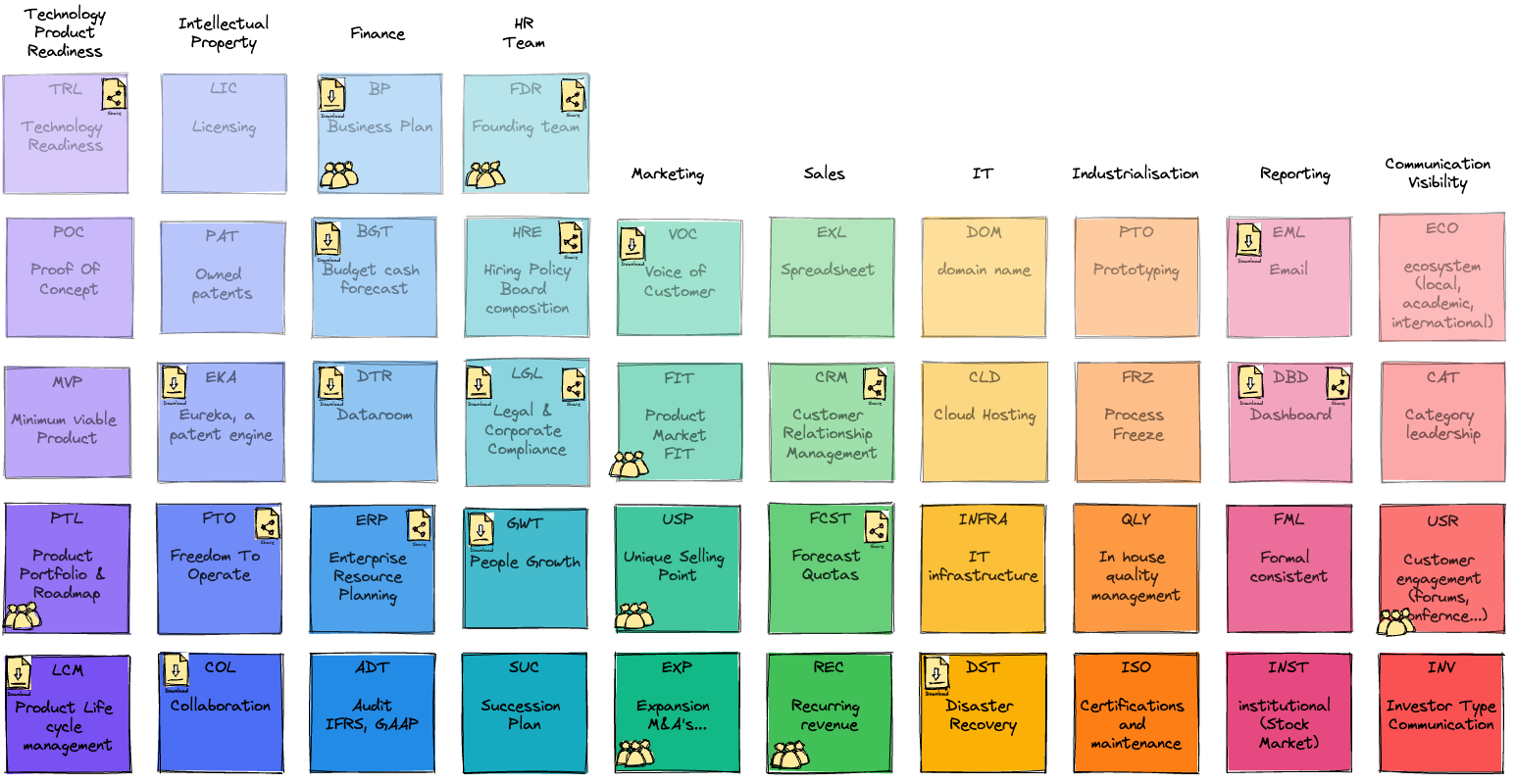
The periodic table of elements is a convenient and well organized representation of the different elements that constitute our world.
Entrepreneurship is about creating something from nothing. It’s about innovating and forming new ideas out of existing materials. Just like the elements in the periodic table, an entrepreneur needs to identify the right combination of elements to bring his/her idea to life.
In the particular context of tech start-ups, the first element is the technology. An assessment of its maturity, or readiness is a critical component of the tech entrepreneur journey.
Next is the context of the technology. Is it licensed from a research laboratory, an university, a private entity? Is the technology patented? An effective way to communicate about this configuration is required.
Next element is the vision the entrepreneur is willing to build for his/her venture. This is best captured in a Business Plan. This describes how the project will evolve to become a company, how it will be built and developed over time. It is an essential tool to communicate the ambition of the project.
Next up are the human resources required to make this idea a reality. This would start with the founding team.
Once these elements are in place, it's time to dive into the execution of building the company. These next steps are either an extension of the four primary elements or additional capabilities to be added:
Financial capital,
Human capital,
Intellectual property such as patents or trademarks,
Business Model,
Marketing strategy,
Operational framework,
Financial projections
Scalability...
Just like every element on the periodic table has its own characteristics, so do the building blocks of the entrepreneurship journey. Every entrepreneur and every founding teams have their own set of skills and abilities that they bring to the venture.
By understanding, nurturing and developing these skills within an organized framework based on principles outlined by this periodic table, entrepreneurs can focus their efforts and energy on building a strong and long lasting venture.
How is the table organized?
Valence (rows) (going down): blocks are organized by their ability to cross serve. For instance, an ERP system will be high on the valence scale as it helps organize the company across the board. Office suite on the other hand, or custom solution have a low valence. It’s very custom and difficult to capitalize across the board. There is a "quick and dirty" component in low valence elements. Increased valence can also be understood as a dependency. The higher the valence, the more a block depends on blocks of other capabilities.
Capabilities (columns): Elements in one column share the same discipline (IP, Finance, Marketing...). Columns are organized by increased capabilities, from fundamental (or required - left) to more sophisticated (right)
Highly required: Finance, technology, IP
More sophisticated (more mature): communication, Industrialisation…